
Canal Crazy – a history of Canals
January 24th, 2017
To trace the origins of canals, we can float back for almost 6,000 years. In Mesopotamia (modern day Iraq and Syria), enormous irrigation canals were built as far back as 4,000 BC. The Grand Canal of China is not only the longest canal in the world but its origins go back to at least 480 BC.
But it wasn’t until the middle of the eighteenth century that Britain fully embraced its own watery transportation system. With the onset of the Industrial Revolution, the country was crying out for a quick, reliable and cost effective method of transporting bulky, heavy goods and raw materials. A rickety horse and cart on muddy and often impassable roads and tracks were no longer sufficient to serve the giants of industry.
It is the 3rd Duke of Bridgewater who is credited with commissioning Britain’s first canal in the 1700s. He needed a way to transport coal from his mines in Lancashire to the fast-growing and coal-hungry mills of Manchester. Said to be inspired by a trip to the Canal-du-Midi in France, the Duke quickly set about finding engineers and builders to work on his project. It cost him greatly (over £23 million in today’s money) but less than a year after its opening in 1761 the price of coal had halved in Manchester, thanks to the increased loads that were able to be transported quickly and cheaply on the long barges pulled by horse power.

Llangollen Canal (wiki commons)
This sparked a flurry of canal building and soon, most of the industrial north and midlands were connected by different branches. Heavy industry relied on the canals to bring raw materials to factories, and then to transport finished products to shipping ports for export across the world. By the turn of the nineteenth century, thousands of barges were carrying thousands of tonnes of goods up and down the country.
Canal construction spurred on important feats of engineering as building challenges were faced and then conquered. Clever engineers and designers of the period were not fazed by any obstacle in the path of an intended canal; aqueducts, tunnels, intricate lock systems and bridges were constructed across the country.
And in Wales, the magnificent Pontcysyllte Aqueduct on the Llangollen canal is perhaps the most famous of its kind. Designed by Thomas Telford and completed in 1805, this ingenious bridge to carry the canal right over the River Dee cemented Telford’s career as the most formidable engineer of his time.
It is the longest and highest aqueduct in the world, and was intended to link this once quiet corner of Wales with the rest of industrial England. Despite much scepticism by other engineers, builders and the public, Telford’s “stream through the skies” as he himself called it, was a huge success and opened to an awed crowd in 1805. Sadly though, only eleven years later the railway arrived at Llangollen signalling the demise of the canal network, and the aqueduct was no longer needed. The fact that it is still fully functioning and sturdy today is testament to Telford’s skills, and is used by pleasure cruisers, walkers and tourists all wishing to catch a glimpse of the Vale of Llangollen as it stretches out below.
In 2009 Pontcysyllte (which literally means “the bridge that joins”) was deemed so important to history, culture and our understanding of the Industrial revolution, that it was inscribed by UNESCO as a World Heritage Site.
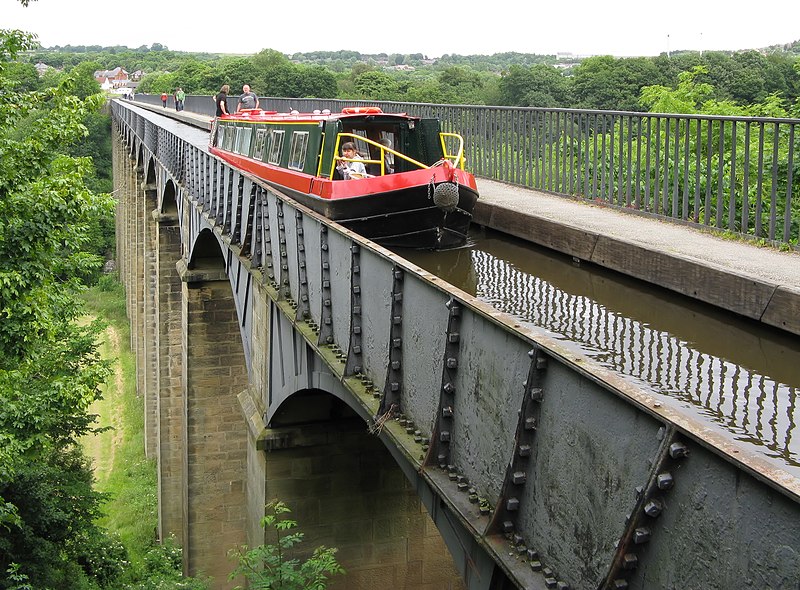
Pontcysyllte Aqueduct (wikicommons)
Sadly, the glittering era of the canal was short lived and the decline in canal use was rapid. By the mid 1800s the railway network was steaming across much of the country, leaving the slow and often fragmented canal system in its wake. Investors lost great sums of money and many canals were left to rot.
Some stretches of canal were even bought by railway companies in a bid to quash the competition, or simply for the land; many were filled in and a railway line placed on top of them. During the mid twentieth century, road haulage became yet another competitor for canal trade and by the 1960s, once busy and industrious canals were still and stagnant. These days, thanks to huge efforts, often by volunteers and enthusiasts, over 2,000 miles of Britain’s fine canal network have been restored and are loved once again. Leisure has replaced heavy industry, but the canals and towpaths of Britain are buzzing with boats, barges and bikes, not to mention a few walkers.