
Discover Seaweed along the Welsh Coast
March 6th, 2020
Did you know that there are almost 700 different types of seaweed to be found along the coast of the UK – that’s nearly two for every day of the week! And it’s true that you can eat seaweed for dinner – humans have been eating seaweed for centuries (like the Welsh delicacy of laverbread) and we also depend on seaweed for making a huge variety of things like toothpaste, cosmetics and medicine.
Seaweed is easily spotted along the Welsh Coast, so next time you head out to the beach why not put your head down and see which you can spot!
1: Bladder Wrack
One of the most common seaweeds you’ll find in Britain, bladder wrack (or Fucus vesiculosus) is typically found all along the coasts of the North Sea, the Atlantic and the Pacific Oceans. It has long tassled fronds dotted with small air pockets. In the early nineteenth century it was used to treat illnesses caused by iodine deficiency.

2: Channelled Wrack
Most often found at the top of the beach where it dries out to become dark and crunchy, Channelled wrack (Pelvetia canaliculata) is common across most of Europe. It grows in thick clusters, clinging to rocks and growing to around 15cm long. It’s name comes from the fact that the fronds start to curl inwards to form a channel, which help keep the seaweed moist when it’s not covered by the sea.

3: Spiral Wrack
Another seaweed mainly found at the top of the shore where it’s drier, spiral wrack (Fucus spiralis) has long and flat fronds which curl as they grow to create spirals. It’s olive brown in colour and can grow to be as long as 30cm!
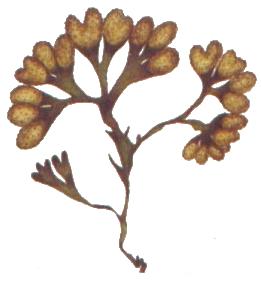
4: Egg Wrack
Egg wrack (Ascophyllum nodosum) is easy to spot because of its long, flat fronds with large egg shaped pockets at regular intervals along each. It’s found across the coasts of Europe and the eastern coasts of America. Some egg wracks have reportedly reached a whopping 2 metres in length! Each air pocket equates to a year of growth.

5: Toothed Wrack
The jagged edges of the Toothed wrack (Fucus serratus) are easy to spot along the lower part of the shoreline because it is one of the most common seaweed species in Britain. The fronds are flat with a central spine that carries water to all parts of the plant. In Scotland toothed wrack is used to make fertiliser.

6: Wireweed
Wireweed isn’t a native British seaweed species; it was thought to be introduced here from Japan in the 1970’s and is now rapidly heading north into Wales from the southern English coasts. This wiry seaweed can grow up to 4 metres in length and each long frond supports many clusters of leaf-type shapes. It likes a wet environment so is found along the lower shores and particularly in rock pools.

7: Sugar Kelp
Sugar Kelp (Saccharrina latissima) is sometimes known as “sea belt” or “devil’s apron” because of its size and shape. Mainly found on rocky sea beds because it enjoys shelter and lots of water, this seaweed species can grow to 4 metres long and 20 cm in width. Sugar kelp often grows in great masses which make them important hiding places and sources of food for other marine wildlife.

8: Green Seaweeds
Green seaweeds (Ulva species) are found on most beaches across Britain, so you’re sure to come across it on a coastal walk. It’s a form of rapidly growing algae and is bright green in colour with delicate leaf-type fronds. It is sometimes called “sea lettuce” because it looks like wet lettuce. Most varieties of green seaweed are edible.
9: Red Seaweed
Red seaweed is one of the least commons types of seaweed in Britain, but three different species have been reported here. It’s easily identifiable by its bright red colour and coral-shaped stiff branches. They like lots of sea water so are usually found in pools or at the shoreline.
10: Laver
Laver is one of the most well-known seaweeds in Wales, if only because it is used to make the traditional delicacy Laverbread (“Bara Lawr”). It’s different to many other common British seaweeds because it is smooth in texture and grows in small sheets, often found clinging to rocks. Raw laver is boiled for a couple of hours and then rolled in oats before frying. Delicious!
